 English
 Ελληνικά
 Italiano
 Español
 Deutsch
 Français
 Português
 Polski
 Nederlands
 Български
 Hrvatski
 Türkçe
 Svenska
 Dansk
Dansk
 Norsk
Norsk
 Shqip
Shqip
Chasing the Epic: the ultimate road-and-ferry guide to Nolan’s Odyssey filming locations
Where movie magic meets the open roads and high seas!Christopher Nolan’s latest big-screen spectacle, Odyssey, aims to thrill audiences with sweeping vistas, ancient monuments, and otherworldly landscapes. But while the film takes us on a mythic journey across space and time, the actual filming locations are firmly rooted right here on Earth.
As road trip enthusiasts with a soft spot for mythology, we at Ferryhopper have mapped out the ultimate itinerary to help you step off the screen and into the frame. Grab your car keys and your sense of adventure (leather sandals are optional, solid driving playlist is non-negotiable), because we are going on an epic road (and ferry) trip across the Mediterranean, the dramatic North and beyond!
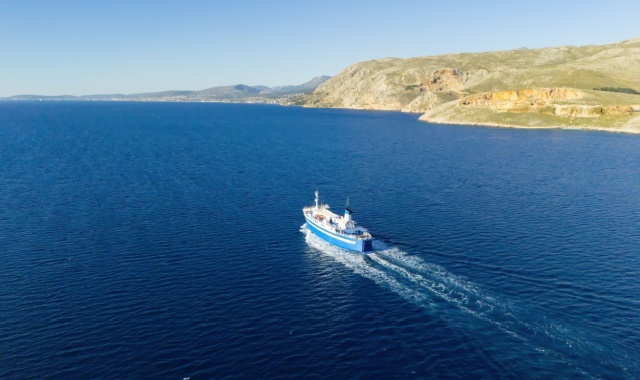
Poseidon's wrath is looking surprisingly peaceful these days
Part 1: The sun-drenched Mediterranean route
If you love ancient history, crystal-clear waters, and the freedom of bringing your own vehicle along for the ride, this first route is a cinematic dream come true.
Leg 1: Greece’s Peloponnese Peninsula
Our journey begins in Athens, where you will hit the road heading southwest toward the Peloponnese. This initial leg connects a stunning cluster of ancient ruins and coastal paradises across roughly 250 km, about a 4.5-hour drive in total (assuming you don't get distracted by the pastry shops along the way).
As you leave the Greek capital behind you and cross the isthmus, the monolithic rock fortress of Acrocorinth rises sharply above the ancient plains. While this citadel is not explicitly mentioned in the Odyssey, Nolan used the ancient fortress to stand in for the soaring, fortified walls of an ancient palace in Ithaca. It’s also famously where where Poseidon, the god of the seas, and Helios, the ancient Greek sun god, had a legendary dispute over the region, eventually compromising by dividing the land. Talk about a high-stakes real estate settlement.
Up next is Ancient Messinia, a sprawling archaeological treasure trove that served as the backdrop for the grand, crumbling palaces of ancient kings in Nolan’s film. Nestled among rolling hills and olive groves, its preserved monumental walls and sanctuaries evoke the grand architectural scale of Homer’s Mycenaean Greece.
The imposing Methoni Castle features grand stone battlements and a striking octagonal tower that juts into the Ionian Sea. The director used its fortified bridges and sea-washed stone walls to capture Odysseus’s departure into the unknown, mirroring the departure from the high-walled city of Troy in Homer's opening songs. Simply put, it’s the ultimate backdrop for dramatic, slow-motion movie walking.
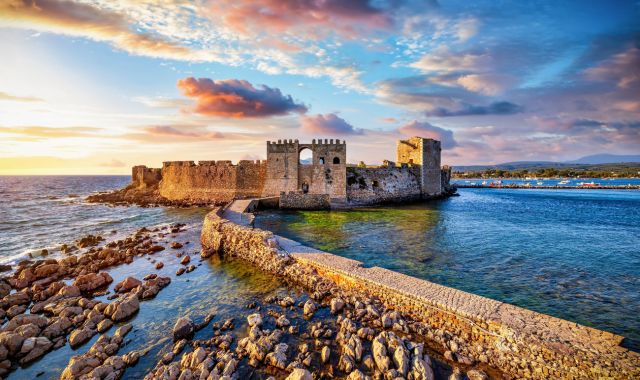
The Castle of Methoni doesn't need any filters
The scenic harbor town of Pylos is wrapped around the historic Navarino Bay, where coastal waters depict the initial naval gatherings of the Greek fleets. In Book 3, Odysseus’s son, Telemachus, travels specifically to “sandy Pylos” to seek news of his missing father from wise King Nestor. Perched nearby, Nestor's Cave was filmed as a secluded, shadowy refuge where characters uncover hidden artifacts. According to legend, this is where Nestor kept his royal herds, which means the ancient cows enjoyed a spectacular ocean view.
Voidokilia Beach forms a near-perfect, symmetrical crescent shape resembling the Greek letter omega (Ω). This is presumably where Nolan filmed a pivotal shipwreck scene where a lone survivor washes ashore. The pale, golden arc of sand and placid turquoise waters perfectly match the sweeping, serene coves that Homer describes.
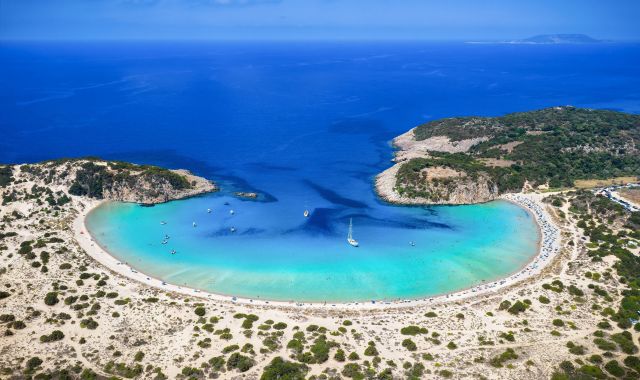
The pale, golden sands and turquoise waters in Voidokilia that Homer raved about
Leg 2: A mythological detour to Ithaca & beyond
After exploring the Peloponnese, drive about 200 km (3 hours) north to the port city of Patras. While the real-world Ithaca wasn't technically featured in the movie, it is the home of the original Odyssey, so it makes perfect sense to drop by since you’re in the neighborhood!
Hop on the Patras - Pisaetos ferry to explore this legendary Ionian island. In Homer's epic, Ithaca is the ultimate destination: the “Island of Return” where Odysseus yearns to return to his wife Penelope, his son, and his household after twenty long years away. Hopefully, by following our plan, your journey shouldn’t take two decades.
Once you’ve soaked up the mythic vibes and explored some of the best Ionian beaches, you have 2 main options to continue your journey toward Italy with your car:
- Take the short Pisaetos - Sami ferry to Kefalonia, spend some time exploring, and catch a direct Sami - Bari ferry.
- Head back to the mainland and catch the direct Patras - Bari ferry.
Pro tip: Make sure to read up on traveling between Italy-Greece with a vehicle when booking your Italy-Greek islands ferry tickets.
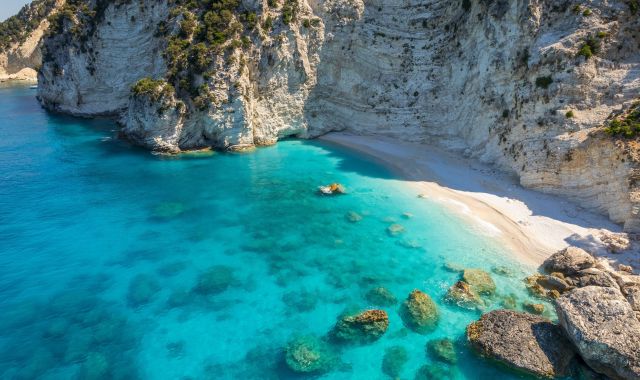
Don't forget to soak up the mythic vibes at Afales in Ithaca
Leg 3: Italy, volcanoes, and island magic
Benvenuti in Italia, epic traveler! From the port of Bari, you drive 430 km (just under 5 hours) south to Villa San Giovanni, where you can catch the ferry across the Strait of Messina and to Sicily. Eearly historians identify this as the real-world location where Scylla and Charybdis tormented Odysseus. Thankfully, modern ferries handle whirlpools and multi-headed sea monsters much better than ancient triremes did.
As soon as you cross over from Villa San Giovanni to Messina, the port city of Milazzo is just a 30-min drive away, which has frequent crossings to the Aeolian Islands. With volcanic craters and bubbling thermal vents, these islands stood in as the surreal, dangerous islands encountered mid-journey. Scholars associate them with Aeolia, the floating mythical island of Aeolus, keeper of the winds, who gifted Odysseus a bag of tempests.
The plan worked until his shipmates opened the bag near Ithaca, blowing them all the way back. Let this be a lesson to never touch your travel buddy's luggage! So, take a leaf out of Odysseus’ book and treat yourself to some island hopping in the Aeolian Islands and tick a few of them off your bucket list! Our Aeolian Islands travel guide can help you figure out where to go, so you don’t spend ages planning your journey.
After your volcanic adventure, it's time to head towards the Egadi Islands, where many pivotal scenes shot and which may have more of a real-world connection to the Odyssey than you'd think. Notably, Samuel Butler controversially proposed that the Odyssey was written here, claiming its descriptions of Ithaca actually mirrored the coastlines of Trapani and the Egadi islands! To find out for yourself, take the ferry to Milazzo and drive west to Trapani in Sicily. From there, you continue with the Trapani - Favignana ferry to visit a stunning island with limestone quarries and translucent sea, where a few key coastal scenes were shot. Favignana is well connected with Levanzo and Marettimo, so you can follow Odysseus' (and Nolan's) footsteps with our 4-day itinerary in the Egadi Islands.
Bonus: Before returning to mainland Sicily, you can also check out the other beautiful islands near Sicily!
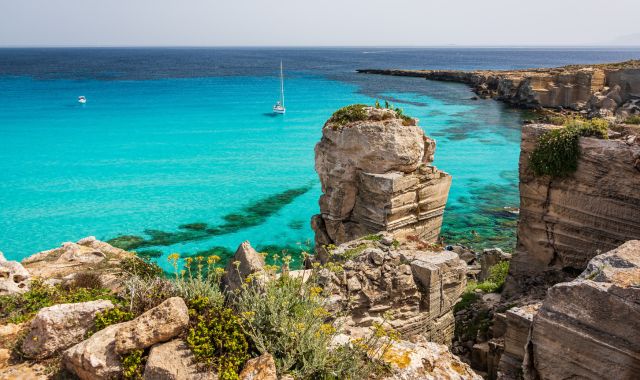
Favignana is also known as the Pearl of the Egadi Islands
Leg 4: Into the Moroccan Deserts
Ready for a true long-haul road trip? The drive from Milazzo to Palermo (200 km) takes about 2.5 hours, where you catch the Palermo - Genoa to northern Italy, from where you continue on the Genoa - Tanger Med ferry to Morocco. Yes, it's a lot of ferry time, but your car gets a break, and you get to enjoy a mini-cruise. Check out the available Italy - North Africa routes to plan this crossing.
In Morocco, the rest of this adventure is purely by car. Be prepared for a massive 1,100 km drive (about 14 hours) across jaw-dropping cinematic backdrops, so be sure to find a guide to keep you on the right track.
Your first stop from Tangier is the breezy, historic port city of Essaouira, with wind-swept stone ramparts, where scenes of tumultuous sea voyages and battering waves were filmed. The crashing Atlantic swells bring to mind the wrath of Poseidon, who constantly battered Odysseus’s fleet across the seas. Bring a jacket, as Poseidon's wrath is surprisingly breezy.
Further down the road, you’ll find the Royal Theatre in Marrakech, an unfinished open-air complex that blends classical symmetry with modern design and was used to film tense confrontations and councils of war. The amphitheater setup directly mirrors the great public assemblies described by Homer.
The final stop on your Moroccan path is Ait Ben Haddou, a striking clay Ksar rising from the desert, which stood in for exotic, ancient market hubs in Nolan’s movie. Its sun-baked clay architecture beautifully evokes the distant, legendary kingdoms of Asia Minor and Egypt that Menelaus and Odysseus speak of visiting.
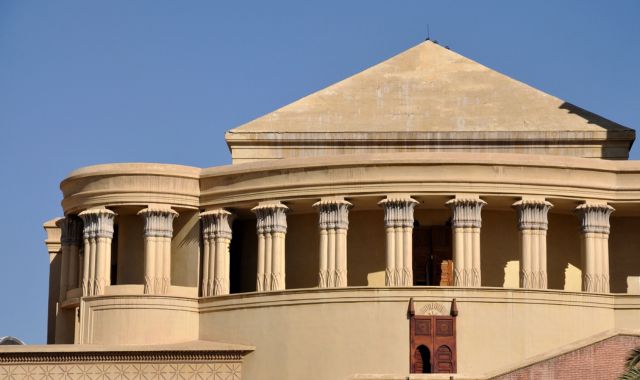
Cue the Ludwig Göransson-penned score as you marvel at the Royal Theatre in Marrakech
Part 2: The Northern Adventure
If dramatic cliffs, moody skies, and black-sand beaches are more your style, Nolan’s northern locations will call to you. Once you touch down and rent a car, the driving routes are spectacular!
Leg 1: Scotland's rugged coastline
As soon as you touch down in the UK, make your way to Moray, on the northern end of Scotland. This region bordering Aberdeenshire and the Highlands stands out for its dramatic, wind-swept coast that Nolan used to channel the isolating and dangerous nature of the open seas. It’s beautiful, moody, and highly likely to mess up your hair.
Your first stop at Sunnyside Beach and Findlater Castle is a 2-for-1, as these locations are within walking distance of each other. The skeletal stone ruins of Findlater Castle sit precariously on a cliff edge overlooking the crashing waves, which Nolan used to represent the literal edge of the known world. This cold, forbidding frontier mirrors the dark, misty borders of the Cimmerian lands described in Book 11 of the Odyssey, where the sun never shines and the dead reside. Perfect for a sunny summer getaway, right?
After exploring the coast, you can drive a short and sweet 70 km westwards to Culbin Forest. This vast, atmospheric pine forest was the perfect scene for capturing the sense of wandering lost in mysterious, enchanted woodlands, much like Odysseus's men traversing the strange island of Circe. Just keep an eye out for anyone trying to turn your travel companions into pigs. The town of Foress is a short 20-min drive away (about 10 km), where you can find a pub and prepare for the next leg.
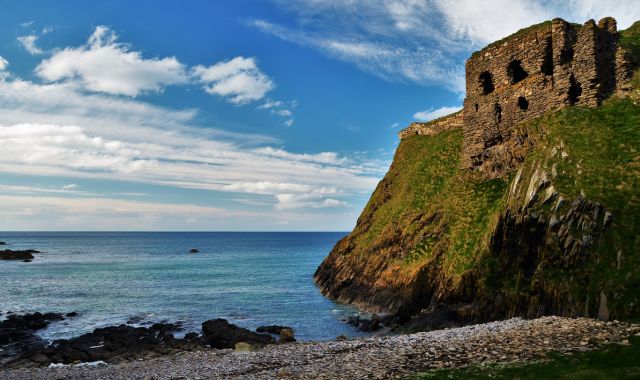
Findlater Castle is all about crashing waves and forgotten kingdoms
Leg 2: Iceland's volcanic wonders
For the truly otherworldly landscapes in Odyssey, the crew headed to Iceland to film environments that look like the realm of the gods themselves. In Reykjavík, rent a 4x4 vehicle (because regular cars don't mix well with volcanic rocks) and embark on a 500 km road trip (approximately 7.5 hours driving).
First, you head north to the vast, desolate, and beautifully moody backdrops of Syðra Skógarnes that the director used to convey the absolute psychological isolation of a lone traveler fighting the elements. This echoes the profound solitude Odysseus felt while stranded on Ogygia, staring out at the barren, featureless horizon.
Next on your journey should be Markarfljót River, a sprawling, braided glacial system that cuts deep, icy channels through volcanic valleys. In the Odyssey, Nolan filmed the primordial landscape to capture the raw, elemental forces of nature that the Greek gods constantly deployed to test humanity's resolve. It's a great reminder that Mother Nature always wins.
The final stop in our Icelandic adventure is Hjorleifshofdi Beach, famous for its towering, monolithic rock formations and striking, pitch-black volcanic sand. Nolan used this stark palette to film scenes of the underworld and encounters with supernatural forces. The eerie, dark sands perfectly visually manifest Homer's Nekuia, the journey to the shadowy, somber realm of Hades where Odysseus pours libations to speak with the dead.
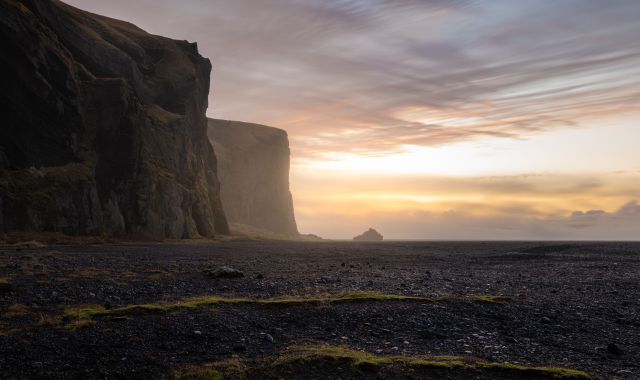
Hjorleifshofdi, when need to turn the atmospherics up to 11
What about the rest?
While Nolan traveled the world to capture these stunning vistas, a movie of this scale still requires some classic Hollywood magic. Several interior and heavy visual effects scenes were filmed on soundstages back in California, including Stage 12 and Falls Lake at Universal Studios in Los Angeles, as well as Stages 9 and 27 at Sony Pictures Studios in Culver City. Sadly, you cannot take a car ferry across the Atlantic to visit these ones.
Ready to embark on your very own cinematic odyssey across the Mediterranean and beyond? Pack your bags, book your ferry tickets on Ferryhopper, and hit the open road!