 English
 Ελληνικά
 Italiano
 Español
 Deutsch
 Français
 Português
 Polski
 Nederlands
 Български
 Hrvatski
 Türkçe
 Svenska
 Dansk
Dansk
 Norsk
Norsk
 Shqip
Shqip
Islands near Split
6 gems to explore by ferryPlanning to island hop from Split but not sure where to start? The port sits at the heart of the Dalmatian coast with direct ferry connections to a remarkable spread of islands, some just 20 minutes away, others a couple of hours out to sea. Catamarans and car ferries run all year round, giving you plenty of flexibility whether you're organizing a day trip from Split or a longer multi-island adventure.
Whether you're after the laid-back pace of an undiscovered olive-grove island, the buzz of a glittering harbor town, a pristine natural park, or some of the Adriatic's clearest diving waters, Split has several nearby gems to discover. Here's Ferryhopper's guide to the islands you can reach by ferry from Split:
1. Šolta
Šolta is the kind of island that rewards people who aren't chasing the crowds. Just across the channel from Split, it's one of the quietest Dalmatian islands, known for its olive groves, dry-stone villages, and a slow pace that feels genuinely unhurried.
The village of Grohote is the island's main settlement, surrounded by old stone houses and the scent of lavender in summer. Head to the bay of Stomorska for a swim in calm, clear water, or make your way to Maslinica on the western tip, a small resort village with a beautiful natural harbor lined with boats and waterfront restaurants serving fresh fish. Paška salata (Dalmatian salted fish salad) is a local staple worth trying at any of the family-run konobas.
Ferries from Split reach Rogač port in just 30 minutes, with 1-2 daily crossings all year round.
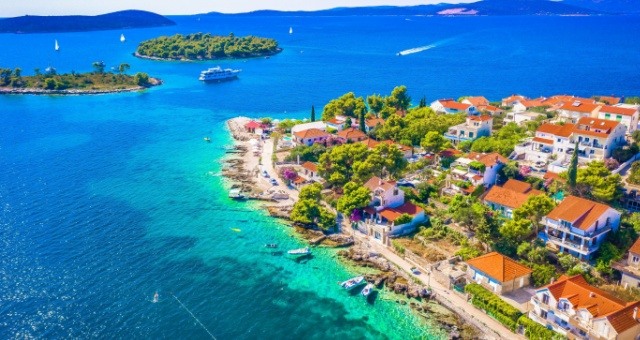
The picturesque village of Maslinica on the island of Šolta
2. Brač
Brač is Croatia's third-largest island and one of the most versatile day-trip destinations from Split. It's famous across the region for its white limestone, which was used to build Diocletian's Palace in Split and, legend has it, the White House in Washington.
The island's undisputed highlight is Zlatni Rat near Bol, a long golden-pebble cape that shifts shape with the currents and is widely considered one of the most distinctive beaches in the Adriatic. Bol itself is a lively resort town with windsurfing, kite-surfing, and excellent seafood. For something quieter, Supetar has a charming harbor front and easy access to the rest of the island by local bus. History lovers shouldn't miss the Blaca Hermitage, a 16th-century monastery carved into a rocky canyon, accessible on foot or by jeep.
The fastest ferry from Split reaches Supetar in as little as 20 minutes, with daily crossings year-round and up to 7 departures a day.
Split - Brač (Supetar) from €10
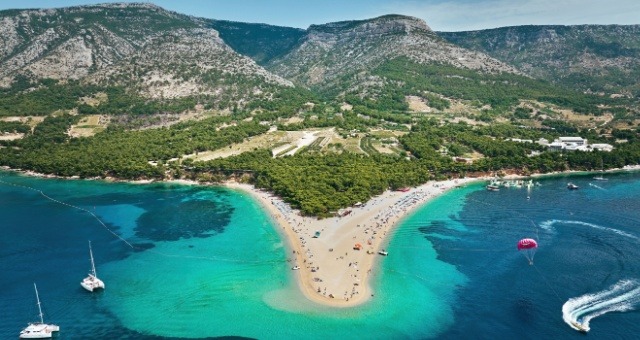
The famous Zlatni Rat beach in Bol on the island of Brač
3. Hvar
Hvar needs little introduction. One of the most visited islands in Croatia, it combines a buzzing old town with genuinely beautiful countryside, and it's easy to see why it keeps drawing people back year after year.
Hvar Town is the place to start: its Fortica fortress above the harbor offers sweeping views over the old town and the Pakleni Islands just offshore. The Cathedral of St. Stephen and the main pjaca (town square) are lovely at any hour, but especially at dusk when the day-trippers start to thin out. Beyond the town, the island opens up into fragrant lavender fields, vineyards, and a string of smaller settlements. Stari Grad, the island's oldest town, has a calmer, more authentic atmosphere, and its plain, a UNESCO World Heritage Site, is crisscrossed with ancient dry-stone walls.
Ferries from Split reach Hvar Town in less than 1 hours. The route runs every day, all year round, with up to 19 daily crossings in summer.
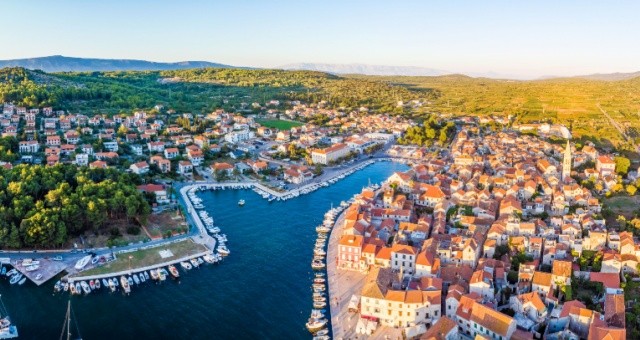
The historic harbor of Stari Grad on the island of Hvar
4. Vis
If the other Dalmatian islands feel too polished, Vis is the antidote. Closed to foreign visitors until 1989 due to its role as a Yugoslav military base, the island has barely caught up with mass tourism and that's entirely its appeal.
Vis Town (also called Issa) has beautiful neoclassical villas along its harbor front, the remains of a 3rd-century Greek theatre, and a string of wine bars and restaurants that punch well above their weight. On the other side of the island, Komiža is a picture-perfect fishing village with a 16th-century Kaštel fortress on the waterfront. From Komiža, you can take a boat excursion to the famous Blue Cave on the nearby islet of Biševo, where sunlight filters through an underwater opening to bathe the interior in an electric-blue glow. Vis is also the place to try vugava, a rare local white wine grown on the island for centuries.
Ferries from Split take 1 hour 10 minutes to reach Vis port, with up to 3 daily crossings in high season.
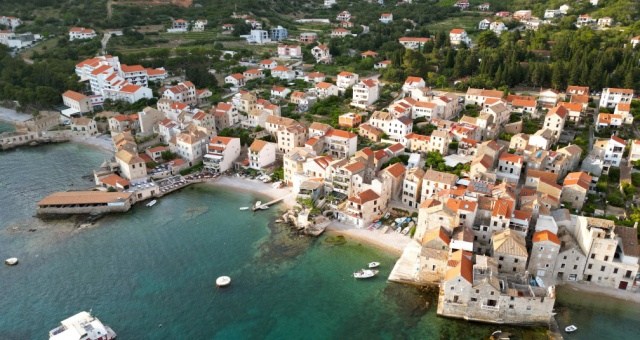
The traditional fishing village of Komiža on Vis island
5. Korčula
Korčula is one of those rare places that lives up to the hype. The medieval walled town on the northeastern tip of the island, built on a small peninsula with a herringbone street layout designed to manage the bura (north wind), is frequently compared to a mini Dubrovnik, and the comparison is fair.
The Old Town is compact enough to walk in an afternoon but rich enough to absorb an entire day. Visit St. Mark's Cathedral, stroll along the Venetian-era walls, and look for the house traditionally identified as the birthplace of Marco Polo (the island claims the explorer as its own, though historians debate it). Outside the town, the island is well worth exploring by bike or moped: the interior is lush with vineyards, and the south coast has quieter beaches far from the crowds. Lumbarda, just 6 km from Korčula Town, produces Grk, a rare white wine grown on sandy soil and found almost nowhere else in the world.
Catamarans from Split reach Korčula Town in 2 hours 20 minutes, with daily crossings year-round and arrivals at both Korčula Town and Vela Luka on the western side of the island.
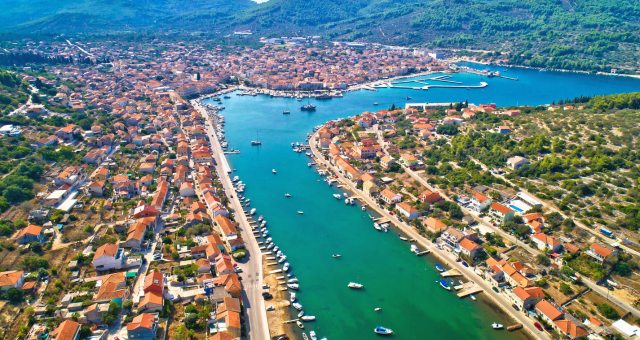
The scenic coastal town of Vela Luka on the island of Korčula
6. Lastovo
Lastovo is the furthest island you can reach by ferry from Split, and arguably the most rewarding for travelers who want to disconnect properly. One of Croatia's least-visited inhabited islands, it belongs to a protected Nature Park and has fewer than a thousand residents, forests covering 70% of its surface, and night skies dark enough to stargaze by.
The island's main village, also called Lastovo, sits in a hollow in the hills rather than on the sea, which gives it a uniquely sheltered, interior feel unusual for a Dalmatian island. The waterfront settlement of Ubli is where ferries arrive, and it's worth lingering before making your way up to the town. Hikers and cyclists can explore 200 km of marked paths that wind through pine and strawberry-tree forest, while divers come for the pristine underwater world around Islet Bijelac and Cape Struga, where gorgonian fans and underwater caves reward those willing to make the journey.
Ferries and catamarans from Split serve Ubli port all year round, with the catamaran crossing taking around 3 hours via Hvar and Vela Luka.
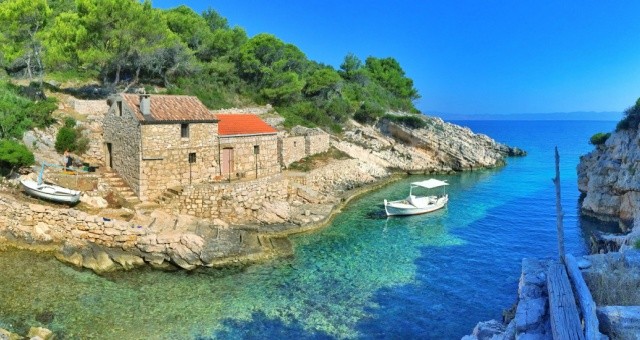
A peaceful stone house and boat in a bay on Lastovo island
Island-hopping around Split: book your ferry tickets
Ready to set sail? On Ferryhopper, you can compare schedules and prices for all ferry connections from Split in one place, with no hidden fees. Whether you're planning a quick day trip to Šolta or stringing together a full week across Hvar, Korčula, and Lastovo, you can find the best prices and book your ferry tickets in just a few steps. Check our Map of ferries to visualize your island-hopping itinerary.