 English
 Ελληνικά
 Italiano
 Español
 Deutsch
 Français
 Português
 Polski
 Nederlands
 Български
 Hrvatski
 Türkçe
 Svenska
 Dansk
Dansk
 Norsk
Norsk
 Shqip
Shqip
Ferry to Ireland: complete guide to routes and crossings
Off to the Emerald Isle!Planning to take a ferry to Ireland? There are regular crossings from England, Wales and Scotland, as well as routes from France to ports in both the Republic of Ireland and Northern Ireland.
With frequent year-round sailings and a range of departure ports to choose from, travelling by sea is both convenient and flexible. Discover all available routes, compare ferry prices and operators, and book your tickets to Ireland on Ferryhopper with no hidden fees.

The atmospheric scenery around the Rosslare lighthouse
What are the ferry routes to Ireland?
You can travel by ferry to Ireland from Wales, England and Scotland in the UK, and France in mainland Europe. The ports that you can reach are on the eastern coast of Ireland:
Ferry to Ireland from Wales
There are many daily ferries to Ireland departing from the ports of Wales. More specifically, you can get to Rosslare and Dublin from Fishguard, Holyhead and Pembroke.
Irish Ferries and Stena Line serve the ferry Wales - Ireland routes and tickets normally start at around €30.
Holyhead to Dublin ferries
The most popular and frequent ferry route to Ireland is the ferry to Dublin from Holyhead, on the Isle of Anglesey. There are usually up to 10 daily crossings all year round, with the journey taking 2 hours and 15 min to 3.5 hours. Tickets cost from €32, and the route is served by both Stena Line and Irish Ferries.
Crossings from Fishguard to Rosslare
You catch a ferry from Fishguard to Rosslare, usually 2 times a day, all year round. The crossing takes 3.5-4 hours and ferry tickets are priced from €44. The route is served by Stena Line.
Ferries from Pembroke to Rosslare
The Pembroke - Rosslare ferry route is served year-round, typically with 2 daily crossings. The ferry ride takes about 4 hours, and tickets cost from €32. This Wales-Ireland ferry route is operated by Irish Ferries.
Ferry to Ireland from England
You can travel by ferry from England to Ireland all year round, specifically from Liverpool to Belfast in Northern Ireland. The ferry route from Liverpool to Northern Ireland is operated by Stena Line and ticket prices normally start at around €40.
Liverpool - Belfast ferries
The Liverpool - Belfast route is served with up to 2 daily crossings by Stena Line. The trip across the Irish Sea usually lasts about 8 hours, and tickets typically cost from €42.
Ferry to Ireland from Scotland
There is a year-round ferry connection from Cairnryan, a seaside village in the county of Wigtownshire in Scotland, to the port of Belfast in Northern Ireland. Stena Line operates the Scotland - Northern Ireland ferry crossings, with ticket prices starting at about €40.
Ferries from Cairnryan to Belfast
You can catch a ferry to Belfast from Cairnryan up to 6 times a day. The crossing takes about 2 hours and 15 min, while ferry tickets are priced from €42.
Ferry to Ireland from France
France is well connected to Ireland by sea. You can reach Dublin from the port of Cherbourg in Normandy, on the northern coast of France. Irish Ferries serves the route between Ireland and France throughout the year.
Crossings from Cherbourg to Dublin
You can travel by ferry from Cherbourg to Dublin with up to 7 weekly crossings by Irish Ferries. The ferry crossings takes approximately 19 hours and tickets start at €57.
Ferry companies operating Irish routes
There are 2 ferry operators travelling to Ireland from the UK and France:

Golden hour along the River Liffey in the heart of Dublin
On-board services and amenities
The conventional ferries travelling to Ireland are equipped with a range of modern amenities and services for a relaxed journey. On board, you will generally find:
- Comfortable seating in air-conditioned lounges and spacious outer decks to enjoy the sea view
- Cafés, bars and restaurants serving light bites, drinks and hot meals
- A range of shops for travel essentials and gifts
- Entertainment, including TV lounges & cinemas, video games, play areas for children and casino game rooms for adults
- Free and premium internet access via Wi-Fi hotspot with a range of data bundles to suit your needs
Accessibility
The ferries to Ireland are generally accessible to travellers with disabilities, featuring ramps and lifts, as well as adapted amenities.
Boarding assistance is typically available upon request and prior notification to the ferry company before your journey.
Note: accessibility features vary from vessel to vessel, so it is recommended to contact the ferry company at the time of booking for further details.
Accommodation options
Cabin types
On the ferry to Ireland, you can usually book a cabin for up to 4 passengers for a more comfortable journey. Typically, you have the option between:
- Standard interior cabins
- Exterior cabins with a sea view
- Deluxe cabins with double bed, tea/coffee maker, mini fridge and sea view
- Wheelchair-accessible cabins
- Pet-friendly cabins
- Shared cabins
All cabins feature en suite facilities, towels, bedding, and a TV with a free video-on-demand service.
Cabin prices normally start from around €75 to €100, depending on the route and company.
Business-class seats
Most ferries to Ireland have a business-class lounge, where you can book a numbered reclining seat with extra legroom. Depending on the vessel and company, these seats may also include access to premium Wi-Fi and panoramic sea views
Prices for business-class seats start from around €55 to €60.
Luggage
Each ferry company serving the routes to Ireland has its own luggage policy
- Stena Line allows you to carry as many bags as you can on board yourself, with no weight restrictions. However, hand luggage must be no larger than 60x50x40 cm..
- With Irish Ferries, you can bring 1 small piece of hand luggage with you, while all other luggage must be checked in, with a maximum weight of 22 kg each item.
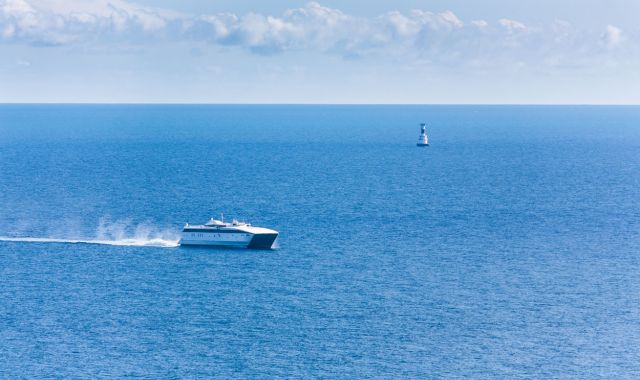
A ferry making its way across the open waters of the Irish Sea
FAQs for planning a ferry trip to Ireland
What's the fastest ferry to Ireland?
The fastest ferries are from Holyhead to Dublin in the Republic of Ireland and from Cairnryan to Belfast in Northern Ireland, with each crossing taking 2 hours and 15 min.
Is there a high-speed ferry to Ireland?
No, the routes to Ireland are typically served by fast conventional ferries.
What is the cheapest ferry to Ireland?
The cheapest ferries to the Republic of Ireland are from Holyhead to Dublin and from Pembroke to Rosslare, with tickets costing from €32.
The cheapest ferries to Northern Ireland are the Liverpool - Belfast and Cairnryan - Belfast routes, with tickets priced from €42.
Bear in mind that any current offers on ferries to Ireland are automatically applied when booking your tickets on Ferryhopper.
Can I bring my car on the ferry to Ireland?
Yes, the conventional ferries serving routes to Ireland feature car decks for transporting vehicles. Prices start at around €160 to transport a car, €40 for a motorcycle and around €175 for a caravan or motorhome.
Tip: if you are travelling with a vehicle, make sure to book your ferry tickets well in advance, as car-deck spaces tend to sell out quickly on popular routes.
Can you do a day trip to Ireland?
Yes, it is perfectly possible do a day trip to Ireland, thanks to the frequent and fast ferry connections between Great Britain and Ireland.
The Holyhead - Dublin route offers up to 10 crossings per day, with the fastest ferries reaching the Irish capital in just 2 hours and 15 minutes. This makes it ideal for a full day of sightseeing, exploring the city’s shops or enjoying Dublin’s famous pubs, before heading back to Wales in the evening.
Similarly, the Cairnryan - Belfast ferry operates up to 4 times a day, with an average travel time of 2 hours and 15 min. This route from Scotland allows you to explore Northern Ireland’s capital and return within the same day.
Can I bring my pet on the ferry to Ireland?
Yes, pets are generally allowed on the ferry to Ireland, provided you include them in your booking.
Typically, pets can either stay with you, in pet lounges or on board kennels, or you can book a pet-friendly cabin. On shorter routes, you may also have the option of keeping your pet in your vehicle.
Smaller pets must remain in a carrier, while larger animals must be kept on a lead and wear a muzzle at all times outside cabins or the kennel area. The ferries have designated walking areas, however pets are generally not allowed in standard cabins, lounges or dining areas.
Remember to bring the necessary travel and health documents, including your pet’s microchip identification, valid rabies vaccination and (for dogs only) tapeworm treatment certificate, tickets, and any pet supplies needed for the trip.
Important: certain dog breeds are not permitted to travel, as they are banned in the UK and Ireland. These include XL Bullies, Pit Bull Terriers (including American, English and Staffordshire Pit Bull Terriers), Japanese Tosa, Dogo Argentino, and Fila Brasileiro.

The breathtaking cityscape of Belfast at sunset
Book your ferry to Ireland on Ferryhopper
The Emerald Isle is waiting for you! Find the ferry that suits you best and get ready to explore the wild beauty of Ireland. Use our Map of ferries to check all available routes and schedules, visualize your trip, and book your tickets in no time!