English
 Ελληνικά
 Italiano
 Español
 Deutsch
 Français
 Português
 Polski
 Nederlands
 Български
 Hrvatski
 Türkçe
 Svenska
 Dansk
Dansk
 Norsk
Norsk
 Shqip
Shqip
Ferry to Calais from Dover
Tickets, prices & schedulesYou can travel by ferry from the port of Dover in southeastern England, UK, to the port of Calais in northern France all year round with around 20 daily crossings. DFDS and Irish Ferries provide crossings every hour throughout the day that take 1.5 hr to cross the Channel, with ticket prices starting at around € 30 per vehicle.
Find updated info, compare ferry schedules, companies and prices for 2026, and book your ferry from Dover to Calais online on Ferryhopper with no hidden fees.
Dover - Calais ferry schedules



How much is the ferry from Dover to Calais?
Take a look at indicative ferry ticket prices for the Dover - Calais route; check the cost for standard tickets, family bookings, and vehicle transportation.
| Calais – Dover | Dover – Calais | |
|---|---|---|
| 1 Adult | € 36.84 | Price not available |
| 2 Adults | Price not available | Price not available |
| 2 Adults, 1 Car | € 74.85 | € 97.5 |
| 2 Adults, 2 Children, 1 Car | € 103.72 | € 106 |
Discounts
Take advantage of the available discounts and travel by ferry to Calais from Dover with lower-cost ferry tickets. Ferry companies offer special discounts for specific passenger categories, such as:
- Children up to 15 years old
- Families with children
Note: Children under 3 years can usually travel by ferry to France from Dover for free. Keep in mind that available discounts can vary from one ferry operator to another.
On-board services and amenities
Ferries to Calais from Dover offer a variety of amenities to ensure a smooth and relaxing journey.
Onboard, you can enjoy spacious seating areas, Wi-Fi access, bars and restaurants serving drinks, snacks, and meals, and shops selling duty-free goods.
Some ferries also include designated play areas for children and kennels for pets.
Find out more about the high-end amenities onboard the Dover to Calais ferry on our dedicated blog.
Cabins and accommodation
Can I book a cabin?
No, since the ferry trip from Dover to Calais is only 1.5 hours, cabins are not available on the ferries from UK to France.
Can I book a business-class seat?
Yes. In addition to standard deck/lounge tickets, some ferries offer business-class seating. These numbered reclining seats are located in an exclusive onboard lounge and provide extra comfort and space.
Business-class seats are typically available for an additional charge of around €30 per traveller.
Luggage
Each ferry company has its own luggage policy:
- On DFDS ferries, each passenger can carry up to 50 kg of luggage. The luggage must be taken by yourself from and on board. Note that there are no luggage carts.
- On Irish Ferries, passengers traveling by car may bring as much personal luggage as they can fit into their vehicle.
Traveling with pets
You can travel with your pet on most ferries from Dover to Calais, provided you include it in your booking. Make sure you carry your pet’s passport and health documents with you, and bring along pet supplies for the duration of the trip.
Important: certain dog breeds are banned and not permitted to travel between the UK and France. These include XL Bullies, Pit Bull Terriers (including American Pit Bull Terriers), Japanese Tosa, Dogo Argentino, and Fila Brasileiro.
Where do pets stay on the ferry?
Usually pets need to stay in your vehicle during the trip or you can book a place in the dedicated pet lounge. The ferries have pet-friendly on board, but during the trip smaller pets must be kept in a suitable carrier, while larger ones must be kept on a lead and wear a muzzle. If your pet stays in your vehicle, leave a window slightly open.
What pet documents do I need?
You must bring your pet’s Animal Health Certificate or EU Pet Passport, including microchip identification and a valid rabies vaccination certificate (at least 21 days before your trip). Dogs will also need tapeworm treatment administered by a vet 1-5 days before returning to the UK.
Boarding procedure at Dover
Navigating the port process for your Dover-Calais ferry crossing is straightforward, but it requires careful timing to ensure a smooth transition across the English Channel. Here is the step-by-step breakdown of what to expect when you arrive at the port:
- Border controls: the port features a dual-stage border control system. You will first pass through French Border Control, where your passports will be checked for entry into the Schengen Area. Following this, you will proceed through UK Border Control, which conducts exit checks on all passengers leaving the country. During peak travel periods, such as school holidays or long weekends, it is highly recommended to arrive at least 2 hr before departure as border authorities work to process high volumes of traffic.
- Ferry check-in: after clearing border control, you then proceed to the check-in booths, with each ferry operator having its own. As you pull up to the booth, automated cameras will scan your number plate to verify your booking details. Have your passport, booking reference, and vehicle registration documents ready to present to the staff. After your details are verified, you will be issued a paper ticket, which indicates the specific marshalling lane you must follow to reach your boarding position.
- Marshalling and boarding: Follow the signage to your allocated lane in the marshalling area and remain with your vehicle until you are instructed by port staff to drive onto the ferry.
Important: After you enter the port area, you may be selected for random security checks of your vehicle, luggage, or person, so have your travel documents ready for inspection.
Note for foot passengers: on Irish Ferries and DFDS ferries, you can only travel with a vehicle. P&O Ferries is the exception, as they permit passengers to travel as foot passengers, without a vehicle. If you are travelling as a foot passenger you will typically be transferred by bus through the check-in process and onto the vessel.
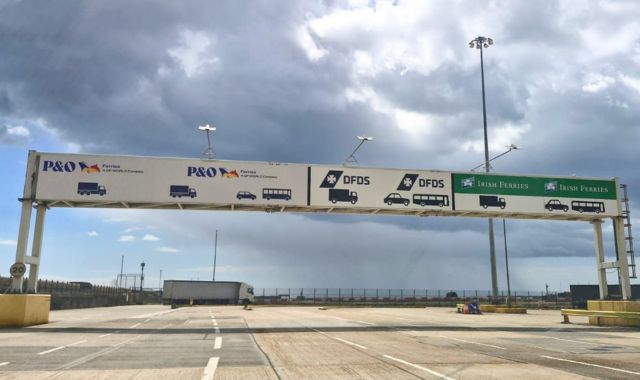
Each ferry company has its own check-in area at the port of Dover
Useful tips for your ferry trip to Calais from Dover
Here are some travel tips for your ferry trip from Dover to Calais:
- Make sure to arrive at the Dover port well in advance, as check-in closes 90 min prior to the scheduled departure time for foot passengers and 60 min prior for all other categories of traffic. The dedicated shuttle bus for foot passengers leaves when check-in closes, 90 min before departure.
- Since there is a 1-hour time difference between the UK and France, don’t get confused with your arrival time!
- Remember that to travel from the UK to France, you will need a valid passport.
- Don't forget to also book your return tickets in advance from Calais to Dover for a hassle-free trip.
- Dover - Calais is the fastest ferry crossing from the UK to France. The proximity of the two ports makes Calais a popular destination for a great weekend trip to France from Dover by ferry.
- You can also travel to France by ferry on the Dover- Dunkirk ferry route. For more details on ticket prices, duration and companies, take a look at the Dover - France routes.
Car on the ferry: the ultimate tip
If you are traveling with friends or family, here is a professional tip: on the Dover - Calais route, the price for a standard car is the same whether there is 1 person or up to 9 people inside!
Since you pay per vehicle and not per passenger, you can fill up every seat in your car without the price going up. This makes the ferry the most budget-friendly way to cross the Channel!
Where to take the ferry from Dover to Calais
Ferries from Dover to Calais depart from the port of Dover in southeastern England, which is one of the world's busiest passenger ports. The port of Dover is around 112 km from London, offering easy access by car via the M20.
If you are travelling to Calais as a foot passenger, you will get to the Passenger Terminal building at Dover’s Eastern Docks first. You will then take a shuttle bus from the Passenger Terminal building to your ferry.
You will find all necessary amenities in the Passenger Services Building (PSB), located on the west side of the port. Facilities include cash and currency services, toilets, cash points, vending machines, free Wi-Fi access, restaurants, and a games room.
How to get to Dover
-
By car: the most direct route from London is via the M20 motorway, which connects directly to the A20 at Folkestone and leads directly to the port. From other parts of the UK, the A2 provides a clear, signposted route into the port. Once you approach the city of Dover, simply follow the brown tourist signs marked "Port of Dover" or "Ferry Terminal."
-
By Train: high-speed rail services run from London St Pancras International to Dover Priory station, with journey times as little as 1 hr 10 min. From the station, the port is a short taxi ride or a brisk 15-20 min walk away.
-
By Coach: several national coach operators, such as National Express, provide regular services to the Dover ferry terminal. This is a convenient option if you are travelling as a foot passenger.
Where does the ferry arrive in Calais?
Ferries from Dover arrive at the Gare Maritime Est terminal in the port of Calais, located a few minutes’ drive from the city centre.
If you're travelling with a vehicle, follow the signs for the A16 and A26 motorways to continue your journey. These motorways connect Calais to Paris, Lille, and other destinations in France and continental Europe, such as Belgium, the Netherlands and countries further south.
There are fuel stations, rest areas, and supermarkets located within a short distance of the port, so you can easily stock up before continuing your journey.
Foot passengers can take a shuttle service from the ferry terminal to the Calais Ville train station. From there, you can take a TER regional train to destinations such as Lille, Dunkirk, and Boulogne-sur-Mer.
Buses also depart from outside the terminal for Calais city centre, where you can find hotels, car rental agencies, and other travel services.
How long is the ferry ride from Dover to Calais?
The Dover to Calais ferry time is approximately 1 hr 30 min, but can vary depending on the season, vessel, ferry operator, and weather conditions.
When does the ferry leave for Calais?
Ferries from Dover to Calais typically depart between 00:15 and 22:50, with crossings almost every hour.
Related posts from our blog


FAQs
No, the vessels operating the route from Dover to Calais are usually conventional ferries. The fastest ferry takes about 1.5 hr to reach Calais.
The distance between the port of Dover in the UK and the port of Calais in France is around 27 nautical miles (approximately 50 km).
All passengers travelling by ferry from Dover to Calais will need a valid passport. British citizens entering the Schengen area must have a passport issued within the last 10 years that is valid for at least 3 months beyond their departure date from the EU.
Visitors from the UK can usually stay in the Schengen area (including France) for up to 90 days in any 180-day period for tourism or similar purposes.
Keep in mind that travel rules may change over time, so we always recommend checking them with the relevant authorities before your travel date.
When travelling from Dover to Calais by ferry you will need your UK driving licence, a valid motor insurance policy that covers driving in Europe and your V5C vehicle registration document. Make sure you have the originals with you, as photocopies are not accepted during checks.
If you are travelling in a hired, leased or company car, or if the vehicle is not registered in your name, you will usually need a VE103/VE103B 'Vehicle on Hire' certificate, or written permission from the owner or leasing company confirming that you are permitted to take the vehicle abroad.
Bear in mind that driving rules can change over time. Before you travel, we recommend checking the latest guidance on the UK Government’s 'Driving in the EU/France' pages and contacting your ferry operator.
Yes, you can travel with your vehicle on ferries from Dover to Calais, including cars, motorhomes, buses, and motorcycles. Prices vary depending on the size and dimensions of the vehicle, as well as the season and ferry company.
Here are some indicative prices:
- Cars: From around €55
- Van: From around €70
- Motorbike: From around €32
- Motorhome: From around €70
Note that you can only travel with a vehicle on Irish Ferries and DFDS trips across the Channel. P&O Ferries allows foot passengers.
Useful info: Remember that you will be driving on the right-hand side of the road once you arrive in France!
No, you can’t stay in your car during the ferry crossing between Dover and Calais.
Once the vessel has left the port, you are not allowed to remain on the car park deck for safety reasons.
However, you can return to your vehicle a few minutes before reaching the port of Calais, following the crew's instructions.
Standard ticket prices on the Dover - Calais ferry route range from € 30 to € 271.5, with Irish Ferries offering the cheapest fare.
Find detailed answers to all your questions about ferry ticket changes, cancellations and refunds.
Remember that you can also use Ferryhopper's online booking modification service, available with certain ferry companies.
If your ferry trip is canceled, you usually have the following options:
- Change your ticket to another departure of equal value.
- Cancel your ticket with a request sent to the ferry operator for a full refund.
Find out more about what you can do in case of weather disruption or ferry strike.
If you’re worried about possible delays or cancellations, you can always visit our ferry travel alerts page for real-time updates on strikes, weather disruptions, and service suspensions.