 English
 Ελληνικά
 Italiano
 Español
 Deutsch
 Français
 Português
 Polski
 Nederlands
 Български
 Hrvatski
 Türkçe
 Svenska
 Dansk
Dansk
 Norsk
Norsk
 Shqip
Shqip
Ferry or LeShuttle (Eurotunnel): which is better for UK-France travel?
Compare journey time, prices, comfort and vehicle optionsChoosing to cross the Channel by ferry or with LeShuttle depends on what matters most to you.
Both options have their advantages: ferries offer a relaxing journey with plenty of space and onboard facilities, while LeShuttle (formerly Eurotunnel Le Shuttle) is the fastest option for crossing between the UK and France with a vehicle.
In this guide, we compare journey times, prices, comfort, pets and vehicle options to help you choose the right Channel crossing.

Two large ferries close to the port of Calais in France
Ferry vs LeShuttle at a glance
| Ferry | LeShuttle | |
| Routes | Multiple UK - France ferries | Folkestone - Calais and Calais - Folkestone |
| Crossing time | From 1.5 hr | About 35 min |
| Foot passengers | Available on select routes | No |
| Cars & motorcycles | Yes | Yes |
| Caravans & motorhomes | Yes | Yes |
| Food and facilities | Available onboard | Available at terminals |
| Pets | Yes | Yes |
| Best for | Space, facilities and route choice | Speed and frequent departures |
Which is faster: ferry or LeShuttle?
The duration of the Dover - Calais ferry ranges from 1 hr 30 min to 2 hr and up to 11 hr on other UK - France ferries. The LeShuttle trains take around 35 min in either direction, whether you travel from Folkestone to Calais or from Calais to Folkestone.
Remember that crossing time is only part of the journey. You also need to allow time for check-in, passport controls and boarding:
- Ferry check-in requirements vary by route, operator and how you are traveling. On the Dover - Calais ferry route, for example, you typically need to arrive at least 2 hr before departure, as vehicle check-in closes 90 min before departure and for foot passengers 60 min ahead of departure.
- For LeShuttle, we recommend arriving at least 1-2 hr before departure, while boarding starts around 25 min before the train leaves.
Additionally, you must also take into account the travel time from the port of arrival to your destination in France.
Is the ferry or LeShuttle cheaper?
Ticket prices for LeShuttle trains from Folkestone to Calais start from around €106 for 1 vehicle, which can carry up to 9 passengers. By ferry, tickets start from around €108 per vehicle for the Dover - Calais crossing.
If you are travelling without a vehicle, then the cheapest option is the Newhaven - Dieppe ferry, with ticket prices starting at around €30, as LeShuttle does not allow foot passengers.
What affects the price?
- Route and accommodation: on UK-France ferries, you often have more travel options, including VIP seats and cabins.
- Travel date and departure time: fares can vary considerably depending on the date, sailing or train departure, and demand.
- How early you book tickets: early-bird discounts and special deals are often on offer for advance bookings.
- Vehicle type and dimensions: prices vary by vehicle type.
- Number of passengers: LeShuttle vehicle bookings can include up to 9 passengers, while ferry fare structures vary by route and operator.
- Return versus one-way travel: operators often offer reduced prices for booking a return trip.
- Seasonal demand: tickets are in higher demand in the high season and around major holidays.
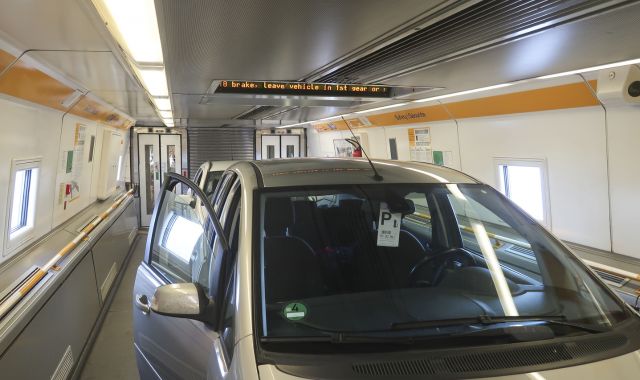
Travelling with a car on the LeShuttle train between England and France
Which is more comfortable?
Ferry experience
Although ferries generally take longer than LeShuttle, the journey can be part of the travel experience rather than simply a way to cross the Channel. Here are some of the main advantages of travelling by ferry:
- Travelling by ferry allows you to take a break from driving, move freely on the vessel and enjoy the sea views from the deck.
- If you’re travelling as part of a large group, you can spend the crossing together in one of the vessel’s communal areas.
- Ferries usually have many communal areas onboard, including cafés, restaurants, lounges, shops, and play rooms for children.
- On longer crossings, you can relax or sleep in a cabin before continuing your journey.
- The ferries have designated pet-friendly areas and, depending on the route, you can keep your pets with you, in your vehicle, in the on-board kennels or in a pet-friendly cabin.
LeShuttle experience
LeShuttle may be the better option if you want a fast crossing and a wide choice of departure times. Its key advantages include:
- The crossing between Folkestone and Calais takes only around 35 min, making it the fastest way to cross the Channel with a vehicle.
- As the journey takes place inside the Channel Tunnel, it is not affected by rough seas.
- During the trip, you remain in your vehicle; there are no passenger lounges, restaurants, cafés, shops or other common areas on the train.
- Pets remain with you in your vehicle during the crossing, provided all applicable travel requirements are met.

The world-famous White Cliffs of Dover from the deck of a ferry
Ferry or LeShuttle for different travelers
Deciding on whether you travel by ferry or with LeShuttle also depends on how you are travelling.
Travelling with children
LeShuttle trains can be very convenient as they take 35 min, however during the trip you must stay in your vehicle. Ferries take longer, but you can move around and have many onboard entertainment options.
Travelling with a pet
On LeShuttle trains, you must keep your pet in your vehicle for the duration of the trip. When travelling by ferry, you generally have more options, depending on the route: you can keep your pet in your vehicle, with you in the pet-friendly areas, in the onboard kennels or you can book a pet-friendly cabin on longer crossings.
Travelling without a vehicle
LeShuttle does not normally accept foot passengers, so you have to travel with an eligible vehicle, such as a car, motorcycle or caravan. On many UK - France ferry routes, you can travel without a vehicle.
Travelling with reduced mobility
The train terminals have many facilities for travellers with disabilities and LeShuttle offers boarding assistance for passengers with reduced mobility; however the trains do not feature any adapted amenities, as you stay in your vehicle for the duration of the trip.
The ferry operators also offer assistance during boarding and disembarkation, while the ferries generally have many adapted amenities in common areas for passengers with reduced mobility.
Travellers prone to seasickness
As LeShuttle travels through the Channel Tunnel, it is not affected by sea conditions. Travelers who are prone to seasickness may therefore find it more comfortable than the ferry.
Does your departure point or destination affect the choice?
Yes, your departure point and ultimate destination in France can affect your choice between LeShuttle and ferries.
- LeShuttle is particularly convenient for southeastern England, Calais and onward travel into northern Europe.
- A ferry from Portsmouth, Poole, Plymouth or Newhaven may reduce total driving for travelers heading toward Normandy, Brittany or western France.
- Choosing the closest arrival port can matter more than choosing the shortest crossing.
Ferry or LeShuttle: which should you choose?
Choose LeShuttle if you are travelling with a vehicle and speed is your main priority. Choose a UK - France ferry if you want more departure-port options, space to move around, onboard facilities, or the option to travel on foot.
Your starting point and final destination also matter: a longer ferry crossing can still produce a shorter overall journey if it reduces the amount of driving required.
FAQs
Is LeShuttle the same as Eurotunnel?
Yes, LeShuttle is the current name of the vehicle train service formerly known as Eurotunnel Le Shuttle. Eurotunnel is still commonly used when referring to the service between Folkestone and Calais.
Is LeShuttle faster than the ferry?
The train ride with LeShuttle usually takes around 35 min, while the shortest ferry crossing, from Dover to Calais, normally takes about 1.5 hr. However, remember to include check-in, border controls and the drive to and from the terminal when comparing the total journey time.
Is the ferry or Eurotunnel cheaper?
Neither option is always cheaper, with the final cost depending on your travel dates, whether you are bringing a vehicle, passenger numbers and ticket conditions. You can compare fares for your exact travel dates when booking your tickets on Ferryhopper.
Can foot passengers use LeShuttle?
No, you cannot normally travel on LeShuttle as a foot passenger. You need to travel with an eligible vehicle, such as a car, motorcycle, camper or motorhome. If you are traveling without a vehicle, selected UK-France ferry routes accept foot passengers.
Is the ferry or LeShuttle better for pets?
LeShuttle may be more convenient if you want your pet to remain with you, as pets stay inside your vehicle throughout the short crossing. On ferries, the pet accommodation options vary by operator, vessel and route: pets may travel in your vehicle, the onboard kennels, with you in the designated pet areas or a pet-friendly cabin.
Can campers and caravans travel on LeShuttle and ferries?
Yes, both LeShuttle and many UK-France ferries accept campers, motorhomes and caravans. When booking your tickets on Ferryhopper, enter the vehicle’s exact dimensions to see the exact cost. Availability and fares depend on the vehicle size, route and departure, so it is best to book larger vehicles in advance.

Ferry crossing the English Channel during sunset
Compare and book your Channel crossing
Ready to travel between the UK and France? On Ferryhopper, you can compare ferry and LeShuttle schedules and prices, choose the crossing that suits you, and book your tickets quickly and easily with no hidden fees.