English
 Ελληνικά
 Italiano
 Español
 Deutsch
 Français
 Português
 Polski
 Nederlands
 Български
 Hrvatski
 Türkçe
 Svenska
 Dansk
 Norsk
 Shqip
Ferry Calais to Dover
Tickets, prices & schedulesYou can travel by from Calais to Dover all year round, with up to 30 daily crossings. The crossing from northern France to southeast England is served with conventional ferries that take about 1.5 hr. Ticket prices for foot passenger start at € 31.39, while tickets with a car start at around € 100.
DFDS and Irish Ferries only accept travellers with a vehicle, while P&O Ferries accepts foot passengers and vehicles. Find up-to-date info, compare timetables, companies and prices for 2027, and book your ferry tickets on Ferryhopper without hidden fees.
Calais - Dover ferry schedules



How much is the ferry from Calais to Dover?
Take a look at indicative ferry ticket prices for the Calais - Dover route; check the cost for standard tickets, family bookings, and vehicle transportation.
| Calais – Dover | Dover – Calais | |
|---|---|---|
| 1 Adult | € 31.39 | € 31.39 |
| 2 Adults | € 74.79 | Price not available |
| 2 Adults, 1 Car | € 74.85 | € 90.82 |
| 2 Adults, 2 Children, 1 Car | € 103.72 | € 106 |
Short break offers
Planning a quick getaway to the UK? On the Calais - Dover route, DFDS and Irish Ferries offer special fares for short return trips:
- DFDS: day returns within 24 hours, 3-day breaks lasting 24-72 hours, and 5-day breaks lasting 72 hours to 5 days.
- Irish Ferries: 2-day breaks of up to 48 hours, 3-day breaks lasting 2-3 days, and 5-day breaks lasting 4-5 days.
Each fare applies to a specific return-travel window. Check the short break label and fare conditions to find the option that fits your plans.
Here's how to book your short break:
- Search for a return trip from Calais to Dover on Ferryhopper.
- Choose a return date that fits the length of your short break.
- Look for the short break label in the search results and select your fare.
Discounts
When travelling by ferry from Calais to Dover, you can take advantage of the regular discounts offered to specific traveller categories. While these discounts differ from one company to another, you can generally expect lower ferry ticket prices for children under 16, while infants and toddlers up to 3 years old typically travel for free.
On-board services and amenities
DFDS, Irish Ferries and P&O Ferries operate the Calais to Dover ferry route with conventional ferries, which are equipped with a range of modern amenities, such as:
- Standard air-conditioned lounges and premium lounges, with complementary drinks and snacks
- Spacious seating on outer decks to enjoy the sea view
- Restaurants, cafés, and bars, serving drinks, snacks and meals (including vegetarian and child-friendly options)
- Family-friendly entertainment, including play areas and a treasure hunt app
- Shops selling duty-free goods, such as cosmetics, perfume, sweets, and alcohol
- Free Wi-Fi hotspot, to stay connected during the trip
For more details and information, have a look at our guide regarding the on-board services of ferries connecting Calais and Dover.
Cabins and accommodation
Can I book a cabin?
No, due to the short length of the trip, there are no cabins available on Calais - Dover ferries. Standard deck/lounge seating is included in the ticket price.
Can I travel first class?
Yes, for a more comfortable journey, you can usually book a seat in the business lounge. Depending on the operator, these tickets may also include priority boarding, as well as complimentary drinks and snacks.
Upgrades for the business lounge generally start at around €20 to €30.
Luggage
Each ferry company serving the Calais - Dover route has its own luggage policy:
- On DFDS ferries, you are allowed as many bags as you can carry on board yourself. Note that there are no luggage carts.
- When travelling with Irish Ferries, you may bring as much personal luggage as you can fit your vehicle.
- With P&O Ferries, you can bring as many pieces of luggage as you can carry onboard yourself.
Pet travel
You can bring your pet with you on most Calais Dover ferries, provided you include it in your booking. Make sure you carry your pet’s passport and health documents with you, and bring along pet supplies for the duration of the trip.
Important: certain dog breeds are banned and not permitted to travel between France and the UK. These include XL Bullies, Pit Bull Terriers (including American Pit Bull Terriers), Japanese Tosa, Dogo Argentino, and Fila Brasileiro.
Where do pets stay on the ferry?
The pet accommodation options depend on the operator:
- DFDS: your pet stays inside your vehicle.
- Irish Ferries: you can keep your pet in your vehicle or in the prebooked Pet Den, available on Oscar Wilde and Isle of Inishmore.
- P&O Ferries: you can either keep your pet inside your vehicle, or alongside you in the Pet Lounge for dogs.
The ferries have pet-friendly areas on board, but during the trip smaller pets must be kept in a suitable carrier, while larger ones must be kept on a lead and wear a muzzle. If your pet stays in your vehicle, bring water, bedding and toys, and leave a window slightly open for ventilation.
What pet documents do I need?
You must bring your pet’s Animal Health Certificate or EU Pet Passport, including microchip identification and a valid rabies vaccination certificate (at least 21 days before your trip). Dogs will also need tapeworm treatment administered by a vet 1-5 days before arriving in the UK.
Useful tips for your ferry trip to Dover from Calais
Here are some useful tips for your ferry trip from Calais to Dover:
- As one of the busiest ports in the world, it is important to arrive at Calais at least 2-3 hr ahead of your ferry’s departure, to ensure a smooth boarding.
- Keep in mind that there is a 1-hr time difference between France and the UK.
- If you are prone to seasickness, consider taking motion sickness medication before the trip. As always, you can discuss your options with your pharmacist or doctor.
- You can also travel to the UK from Dieppe, Dunkirk, Caen, Cherbourg, Le Havre, Saint-Malo and Roscoff. For more details on all routes, ticket prices and operators, check out our blog on France to UK ferries.
- If you are headed to the UK for a short trip, have a look at the Dover - Calais ferry schedules to plan your return to France.
- From England, you can also travel to the Dutch ports of Amsterdam and Hoek van Holland. For more details, check out our detailed guide on UK - Netherlands ferries.
Car on the ferry: the ultimate tip
If you are traveling with friends or family, don't forget that on Calais - Dover ferries, the price for a standard car is the same whether there is 1 person or up to 9 people inside!
Since you pay per vehicle and not per passenger, you can fill up every seat in your car without the price going up. This makes the ferry the most budget-friendly way to cross the English Channel!
Where to take the ferry from Calais to Dover
Ferries to Dover leave from the Port of Calais ferry terminal (Gare Maritime Est), which is on the waterfront, roughly 2-3 km east of the city centre and about 120 km from Lille Airport. When you reach the port, you’ll find well-signposted lanes leading you to the check-in booths and dedicated marshalling lanes for cars, caravans and lorries.
At the ferry terminal, there are also cafés and restaurants, toilets, seating areas, and duty-free shops, which are handy if you want to pick up a few last-minute essentials for the trip. Free drop-off and short-stay parking is available outside the passenger terminal, but the port does not provide medium- or long-stay parking.
How to get to the port of Calais
- By car: approach via the A16 or A26, following signs for Car Ferry.
- By shuttle bus: the free Balad’in connects the ferry terminal with Place d’Armes, Calais-Ville railway station, the town hall and Boulevard Lafayette.
- By train: Calais-Ville, in the town centre, is the most convenient station for the Balad’in shuttle. Alternatively, take a taxi to the terminal in around 10 min. From Calais-Fréthun, where high-speed trains stop, allow roughly 20 min by taxi.
- By taxi: the ride from central Calais usually takes 5-10 min.
- From the airport: the drive from Lille Airport takes approximately 1.5 hr. For public transport, travel via Lille and take a train to Calais, followed by a taxi or local shuttle.
Check-in and boarding at Calais
Plan to reach the port at least 2 hr before departure, allowing extra time during busy holiday periods. Check-in usually closes 1 hr before sailing for vehicles and 1.5 hr ahead of departure for foot passengers and travellers with pets. Follow your booking confirmation if it specifies an earlier arrival time, and remember that departures from Calais use local French time.
- When travelling with a vehicle: check in at your operator’s booth with your booking reference and all passengers’ travel documents ready. You then pass through French exit controls followed by UK Border Force checks, both before boarding in Calais. Security checks may also involve your vehicle or luggage. After clearance, join the numbered boarding lane shown on your boarding pass and wait for staff instructions.
- Foot passengers: you can only travel on foot with P&O Ferries, as DFDS and Irish Ferries do not accept foot passengers on this route. After checking in, a company shuttle takes you through French and British border controls and then to the ship. Keep your boarding pass and travel documents accessible throughout the transfer.
Where does the ferry arrive in Dover?
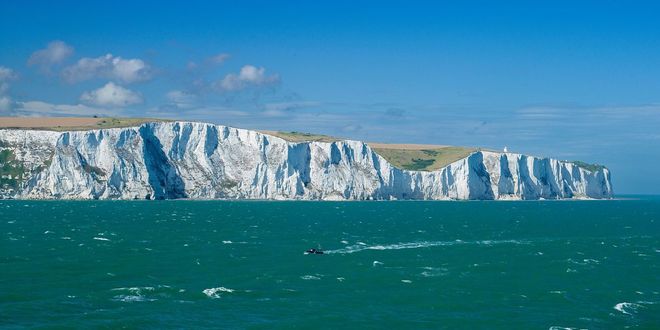
Ferries from Calais arrive at the Eastern Docks at the Port of Dover, beneath the White Cliffs and around 1.5-2 km from the centre of Dover and Dover Priory railway station. This is Dover’s cross-Channel ferry terminal, separate from the cruise terminals at the Western Docks.
If you’re travelling on foot, a ferry transfer takes you to the Passenger Terminal, where you’ll find toilets, coffee outlets and a taxi rank. Once outside the port, you can follow the seafront towards the town centre for more cafés, shops and accommodation.
Onward travel from Dover port
Once you leave the Eastern Docks, you can continue by car towards London or explore nearby towns in Kent. If you’re switching to public transport, head to Dover Priory railway station, approximately 2 km from the terminal entrance.
- Dover town centre: the drive takes 5-10 min from the terminal entrance. Alternatively, Stagecoach bus 66 links the Eastern Docks with the town centre and station.
- London: drive via the A20/M20 or A2/M2, allowing around 2-2.5 hr to central London, while the high-speed trains from Dover Priory reach London St Pancras in just over 1 hr.
- Canterbury: follow the A2, allowing approximately 25-35 min by car. Direct trains from Dover Priory to Canterbury East take around 25-30 min.
- Folkestone: take the A20 west, with a typical driving time of 20-25 min. Trains from Dover Priory to Folkestone Central take approximately 10-15 min.
How long is the ferry ride from Calais to Dover?
The duration of the Calais - Dover ferry trip normally ranges from 1 hr 30 min to 1 hr 40 min, depending on the vessel, ferry company, and weather conditions.
When does the ferry leave?
The earliest ferry usually sets sail at 00:50, while the last ferry of the day departs at around 23:10.
Related posts from our blog


FAQs
The documents you need for the Calais - Dover ferry depend on your nationality and UK immigration status:
- British and Irish citizens: bring a valid passport, you do not need a visa or ETA.
- Other EU/EEA and Swiss citizens: you generally need a passport valid for your entire stay and an ETA for a short visit, unless exempt. National ID cards are accepted only in specific circumstances, including for eligible travellers with settled or pre-settled status.
- Other nationalities: bring a passport valid for your entire stay, plus a UK visa or ETA, depending on your nationality and reason for travelling. Obtain any required permission before departure.
Keep your ferry booking confirmation accessible. If you’re bringing a vehicle, also carry your driving licence, vehicle registration document and valid proof of insurance.
The ferries serving the Calais - Dover route have car decks for transporting vehicles, with the cost depending on vehicle type, travel dates and operator.
Prices for travelling with a car start from around €100, about €65 with a motorbike and €150 with a caravan or motorhome.
Yes, on the Calais to Dover ferry route, P&O Ferries allows foot passengers and vehicles. Keep in mind though that DFDS and Irish Ferries only accept passengers travelling with a vehicle.
No, the Calais to Dover ferry route is normally served by conventional ferries. The fastest ferries are the Isle Of Inishmore and Oscar Wilde operated by Irish Ferries, which need 1 hr 30 min to cover the distance from France to England.
The distance between Calais and Dover is 27 nautical miles (approximately 50 km).
With DFDS, Irish Ferries and P&O Ferries, you can book your tickets online on Ferryhopper and pick them up in paper form from the company’s collection points at the port before the trip.
Find detailed answers to all your questions about ferry ticket changes, cancellations and refunds.
Remember that you can also use Ferryhopper's online booking modification service, available with certain ferry companies.
If your ferry trip is canceled, you usually have the following options:
- Change your ticket to another departure of equal value.
- Cancel your ticket with a request sent to the ferry operator for a full refund.
Find out more about what you can do in case of weather disruption or ferry strike.
If you’re worried about possible delays or cancellations, you can always visit our ferry travel alerts page for real-time updates on strikes, weather disruptions, and service suspensions.