 English
 Ελληνικά
 Italiano
 Español
 Deutsch
 Français
 Português
 Polski
 Nederlands
 Български
 Hrvatski
 Türkçe
 Svenska
 Dansk
 Norsk
 Shqip
Ferryhopper Price Index for Q3 2026
New Ferryhopper analysis reveals contrasting pricing movements across European ferry connections, highlighting the importance of route-level insights for understanding market developments.
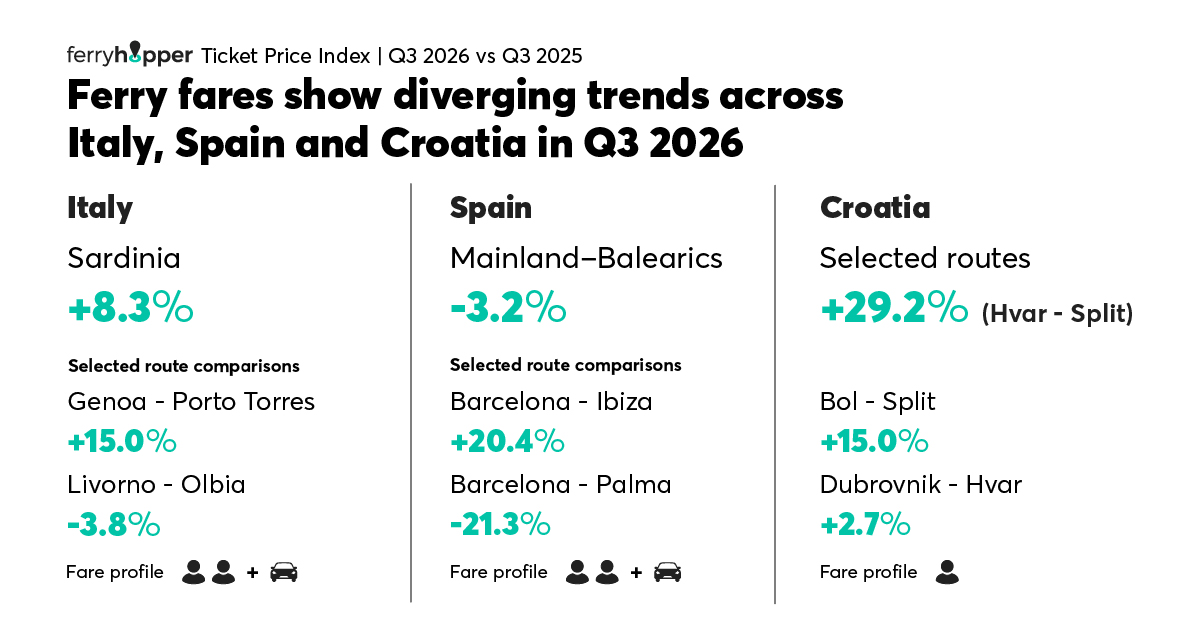
The Ferryhopper Ticket Price Index for Q3 2026 reveals a mixed pricing landscape across selected ferry markets in Italy, Spain and Croatia, with significant differences between regions and individual connections.
Comparing representative fares in Q3 2026 with the same period in 2025, the analysis shows increases across several Italian ferry markets, modest declines in the Balearic Islands, and more pronounced upward movements on selected Croatian domestic routes.
The findings underline that ferry pricing does not follow a single trend across markets. Even within the same region, individual connections can move in opposite directions, reinforcing the importance of examining route-level developments rather than relying exclusively on broader market averages.
1. Key Findings
Italy: Sardinia and Sicily record increases, while individual routes follow different trends.
Representative fares for two adults travelling with a car increased by 8.3% in Sardinia and 5.7% on Sicily's long-distance connections. Elba recorded a 12.8% increase, while selected Italy–Greece routes registered an overall decline of 2.9%. Passenger-focused connections around the Gulf of Naples and Amalfi Coast remained comparatively stable.
Spain: Balearic fares decline, while connections serving Morocco, Ceuta and Melilla increase.
Representative fares for two adults travelling with a car declined by 3.2% on mainland–Balearic connections, while passenger-only inter-island fares in the Balearics decreased by 2.1%. In contrast, connections serving Morocco, Ceuta and Melilla recorded a 10.1% increase, although differences in data coverage between the two periods should be considered when interpreting this result. Canary Islands inter-island fares increased moderately by 3.7%.
Croatia: Selected domestic routes show more pronounced increases.
Among the Croatian connections analysed, Hvar - Split recorded the largest increase (+29.2%), followed by Bol - Split (+15.0%). Dubrovnik - Korčula (+5.9%) and Dubrovnik - Hvar (+2.7%) experienced more moderate movements. These figures refer to representative fares for one adult passenger.
Taken together, the findings highlight a differentiated pricing environment in which individual routes can develop independently of broader regional trends.
2. Italy: Regional increases mask contrasting route-level movements
In Italy, representative fares for two adults travelling with a car increased across several of the selected markets.
| Market | Q3 2025 | Q3 2026 | YoY |
| Sardinia | €136.73 | €148.09 | +8.3% |
| Sicily - long-distance routes | €173.34 | €183.14 | +5.7% |
| Elba | €73.48 | €82.88 | +12.8% |
| Italy - Greece | €277.77 | €269.66 | −2.9% |
Sardinia provides a clear example of the differences that can emerge within a single ferry market. While the regional benchmark increased by 8.3%, Genoa - Porto Torres recorded a 15.0% increase, compared with a 3.8% decline in Livorno - Olbia.
Sicily's long-distance connections showed a more consistent upward movement. Genoa–Palermo increased by 4.3%, while Naples - Palermo recorded an 8.2% rise.
On international connections between Italy and Greece, the overall decline of 2.9% also concealed contrasting route-level developments. Ancona - Igoumenitsa increased by 7.4%, while Bari–Patras declined by 17.2%.
A different picture emerged across passenger-focused markets around the Gulf of Naples and Amalfi Coast, where representative fares for one adult remained comparatively stable.
These findings illustrate how regional pricing movements can reflect substantially different developments across individual ferry connections.
3. Spain: Balearic declines contrast with increases on other connections
Spain's selected ferry markets presented a similarly differentiated picture in Q3 2026.
For longer-distance connections involving vehicle travel, the Index examines representative fares for two adults travelling with one car.
| Market | Q3 2025 | Q3 2026 | YoY |
| Morocco, Ceuta & Melilla connections | €234.42 | €258.20 | +10.1% |
| Balearic Islands - Mainland | €99.08 | €95.95 | −3.2% |
The 10.1% increase across connections serving Morocco, Ceuta and Melilla was accompanied by considerable differences between individual routes. Algeciras - Ceuta recorded a 22.9% increase, while Algeciras - Tanger Med increased by 7.4%. Barcelona - Tanger Med moved in the opposite direction, declining by 12.0%.
Mainland–Balearic connections also showed contrasting movements. Barcelona–Palma recorded a 21.3% decline, while Barcelona - Ibiza increased by 20.4%.
For passenger-focused inter-island travel, the picture differed between the Canary and Balearic Islands.
| Market | Q3 2025 | Q3 2026 | YoY |
| Canary Islands - Inter-island | €39.71 | €41.15 | +3.7% |
| Balearic Islands - Inter-island | €50.27 | €49.22 | −2.1% |
In the Canary Islands, Corralejo-Playa Blanca recorded a 9.0% increase, while La Graciosa–Órzola declined by 3.9%.
In the Balearic Islands, the overall 2.1% decrease in passenger-only inter-island fares concealed substantial differences between routes. Ibiza - Palma de Mallorca declined by 20.9%, while Ibiza- - Formentera increased by 16.9%.
The results highlight the importance of examining individual connections, as regional movements do not necessarily reflect the pricing developments experienced across every route within a market.
4. Croatia: Selected domestic connections record notable fare increases
In Croatia, the analysis of selected domestic ferry connections shows positive year-on-year movements across all four routes examined.
The results refer to representative fares for one adult passenger travelling without a vehicle.
| Route | Q3 2025 | Q3 2026 | YoY |
| Hvar - - Split | €16.12 | €20.83 | +29.2% |
| Bol - - Split | €21.00 | €24.14 | +15.0% |
| Dubrovnik- - Korčula | €21.18 | €22.43 | +5.9% |
| Dubrovnik- - Hvar | €48.67 | €50.00 | +2.7% |
Hvar-Split recorded the strongest increase among these connections, with representative fares rising from €16.12 to €20.83.
Bol- - Split followed with a 15.0% increase, while the Dubrovnik connections included in the analysis experienced more moderate changes.
The differences between these routes reinforce the importance of assessing pricing developments at connection level, even within the same national market.
5. What the findings mean for the ferry industry
Across Italy, Spain and Croatia, the Q3 2026 findings point to a common conclusion: ferry pricing trends are highly dependent on the characteristics of individual markets and connections.
Regional benchmarks offer a useful starting point, but they do not always capture the full range of movements taking place within a market. In some cases, increases on certain routes coexist with declines on others, while different fare profiles can reveal distinct pricing patterns.
For ferry operators and other industry stakeholders, this makes route-level analysis particularly valuable. Understanding where representative fares are increasing, decreasing or remaining stable can provide a more detailed perspective on market developments and support more informed commercial discussions.
Methodology
The Ferryhopper Ticket Price Index compares representative ferry fares across selected connections in Q3 2025 and Q3 2026, covering July, August and September.
The analysis uses fare profiles that reflect the characteristics of each market. These include one adult passenger travelling without a vehicle for passenger-focused routes and two adults travelling with one car for selected vehicle-oriented connections.
Italy: The passenger-only analysis uses Ferryhopper Pricing Catalog data, while the car-based analysis uses booking-level data, including early-booking promotional fares. Representative prices are based on the median of the lowest-priced 25% of qualifying fare observations, with results calculated across the comparable routes included in each market.
Spain: The analysis uses Ferryhopper Pricing Catalog data for both fare profiles. Each eligible catalog observation uses a representative price based on the lowest-priced quartile, while market-level results are calculated as arithmetic means across eligible route-direction, operator and month observations. Results are not weighted by booking volumes. Differences in route-month and operator coverage between years may affect comparisons, particularly for connections serving Morocco, Ceuta and Melilla.
Croatia: The reported route-level comparisons refer to representative fares for one adult passenger on selected domestic connections. Further methodological details are pending confirmation.
The Index covers selected representative connections rather than every ferry route operating within the markets analysed.
No single Europe-wide average is calculated. Differences in fare profiles, data sources and market coverage mean that the results should be interpreted within their respective market and methodological contexts.